General,AI,ML
12 Dec, 2025
Before You Add AI to Your Business, Fix This One Thing First
 By Admin
By Admin
By Admin
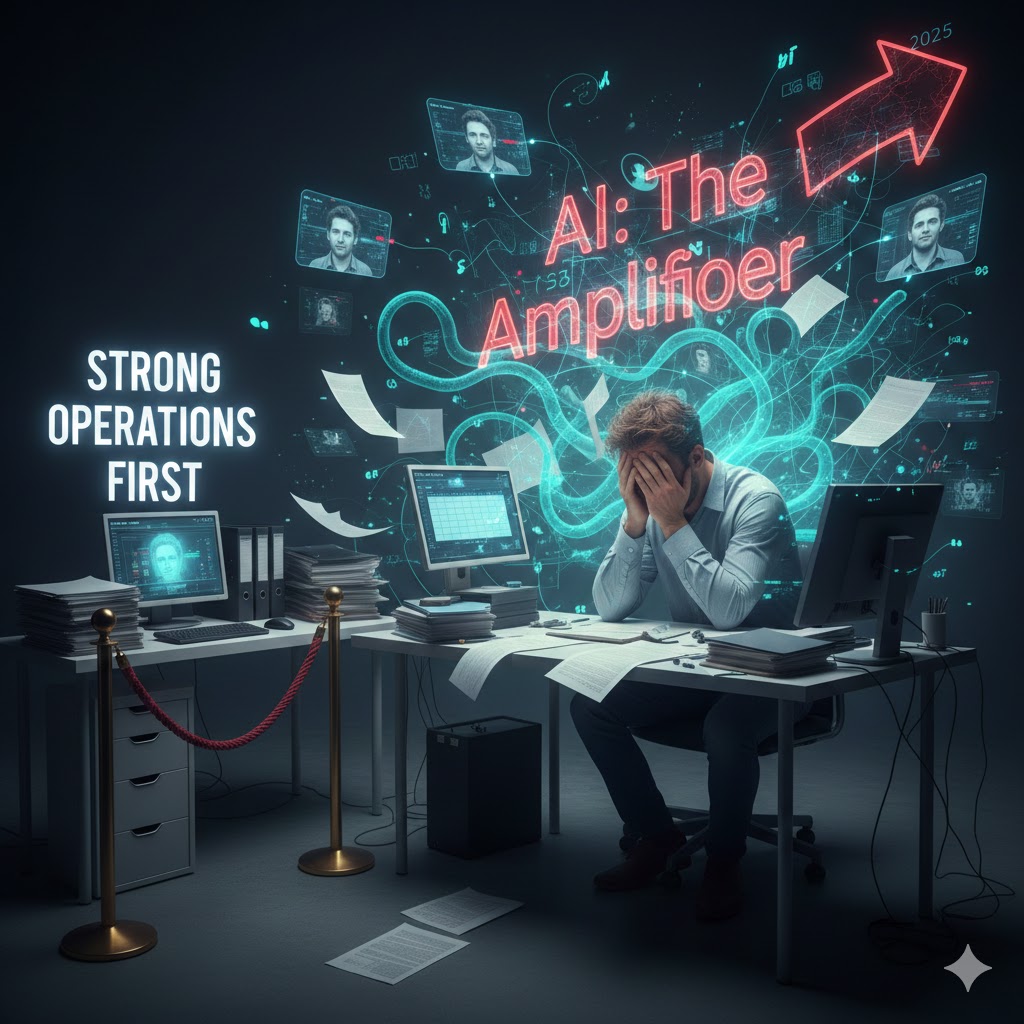
2025 is almost over, and if there is one thing I learned, it’s that AI doesn’t fix operational problems it multiplies them.
I see a lot of founders rushing to plug AI into every corner of their business because they feel overwhelmed, and honestly, I did the same. I assumed automations and AI agents would clean up my workload. Instead, they just made everything louder and faster.
Like most small business owners, I hit a point where I was buried in tasks, approvals, messages, and tiny decisions that somehow always found their way back to me. So, I thought the solution was simple: automate it all. I set up AI tools, created workflows, connected everything with Make and Zapier, and even experimented with AI assistants for client communication. For two weeks straight, I convinced myself I was “building an AI-powered business.”
But the truth? I was just speeding up the chaos I already had.
Bad workflows became automated bad workflows. Confusing instructions became AI-generated confusing instructions. Missing steps became perfectly duplicated missing steps. And every mistake I used to catch manually started repeating on its own because I had essentially put it on a high-speed conveyor belt. The volume of errors increased exponentially, demanding even more of my time for firefighting and clean-up than before.
The core issue lies in our perception of AI as a magical solution. It's not. If you bring AI into a messy operational environment, you won’t get leverage, you’ll get acceleration. And usually, it accelerates the wrong things. AI isn’t a fixer; it’s an amplifier.
Before you invest in the next "AI-powered" solution, you must ask yourself one critical question: Is the process I'm automating clean, efficient, and well-documented? If the answer is no, then AI will simply scale the inefficiency. Your primary focus must be on creating strong, documented, and reliable operations first. Only then, when you introduce AI to those optimized systems, does it actually feel like true leverage reducing friction, not amplifying existing faults.
This lesson cost me time, money, and mental energy, but it clarified the roadmap for 2026: Strong operations first, AI second.
Curious if anyone else has experienced this, especially now that every GPT wrapper calls itself an AI startup and overpromises.
We’ll never share your details. View our Privacy Policy for more info.


